01One pack, not a stack of tools
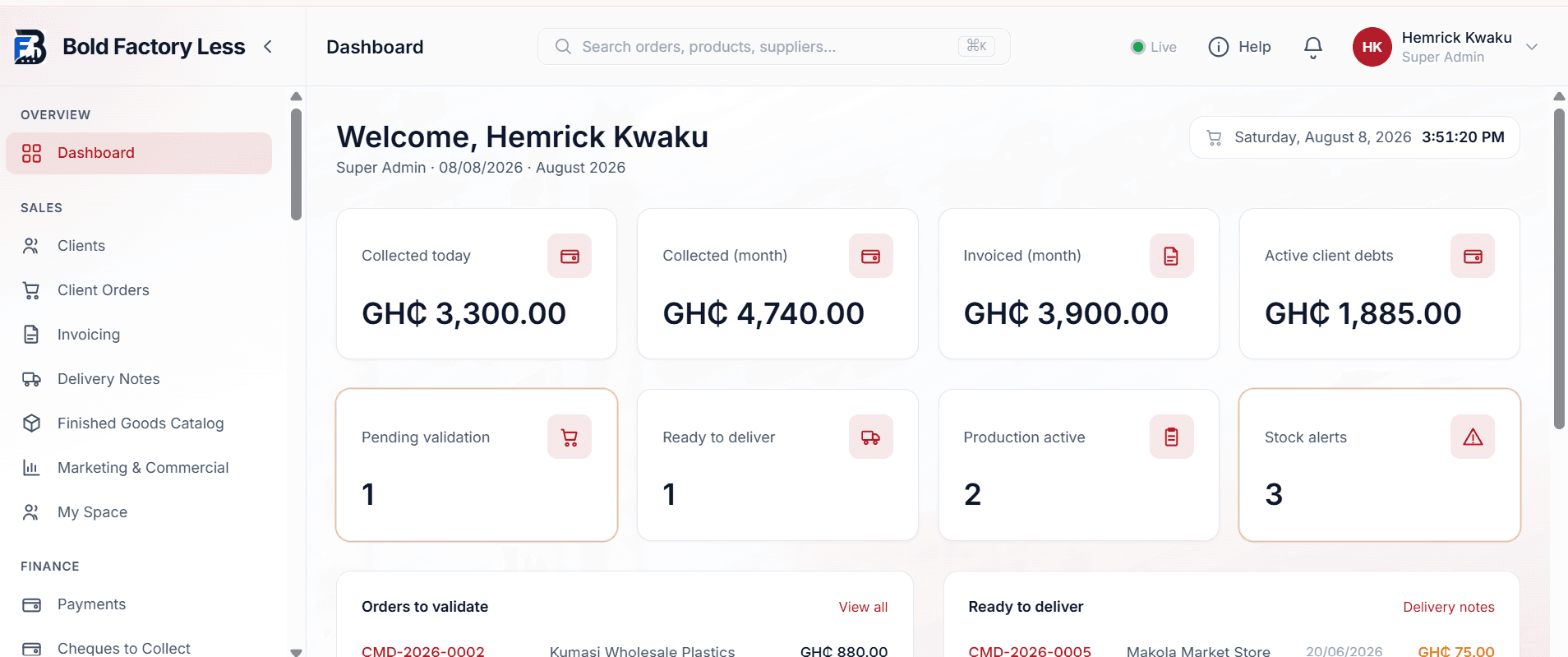
Many factories run on an accounting package, a stock spreadsheet, a payroll tool and a notebook at the weighbridge, then spend the month making them agree. Here it is all one: more than fifty modules sharing the same data, from the truck on the scale to the balance sheet, with nothing to add on and nothing to connect. The breadth you would otherwise look for in the largest ERPs, at the scale of a factory that is growing.
02The cost of a real solution, without the cost of a big ERP
A factory does not need to spend a fortune, wait eighteen months and hire consultants to know what a batch cost. BFL brings the same rigour, at a scale a growing factory can carry: perpetual stock, real cost price, double-entry books.
03Accounting that keeps itself: you come to read it
Nobody re-types anything into the books. Confirming a delivery moves the stock and posts the cost of sales in the same transaction; a payroll run, a loss in transit, a damaged return each write their own entry. So your accountant stops keeping the books and starts reading them: the statements are up to date every day, every line traces back to its entries, and every entry names the document that produced it. And the software always cites a role, never a hard-coded account number, so the chart of accounts stays yours.
04Rights given gesture by gesture
Declaring is not validating. Granting is not disbursing. Keeping a recipe is not touching prices. Every decision that matters has a right of its own, from correcting a recorded error to granting a discount at the counter, with a preset per role and an override per person. And a role can work without ever seeing an amount.
05It refuses to invent a number
When an item has no weight in the catalogue, the software does not compare a partial load: it names the item to complete. A missing figure is said out loud, because a false variance accuses an innocent driver.
06Made for the way African factories actually run
Cash, mobile money, cheques after clearing, several banks. Country and currency chosen at installation, from 41 countries. Taxes and contributions stay the company's to set, because rates change by decree; a country pack can install them in one click, checked on their official sources, and a new rate never rewrites the past.
07A document handed over is never rewritten
An invoice, a receipt or an advice note freezes the moment it leaves your hands. What happens next is added under its own number, not silently written over the old one. That is what lets you find, a year later, exactly the paper the customer is holding.
08A cheque received is not money received
Cheques wait on their own account, outside the treasury, until the bank credits them. Your cash position shows what you can actually spend. And if one bounces, the receivable comes back to life on its own, with a letter for the customer.
09The annual report checks itself in front of you
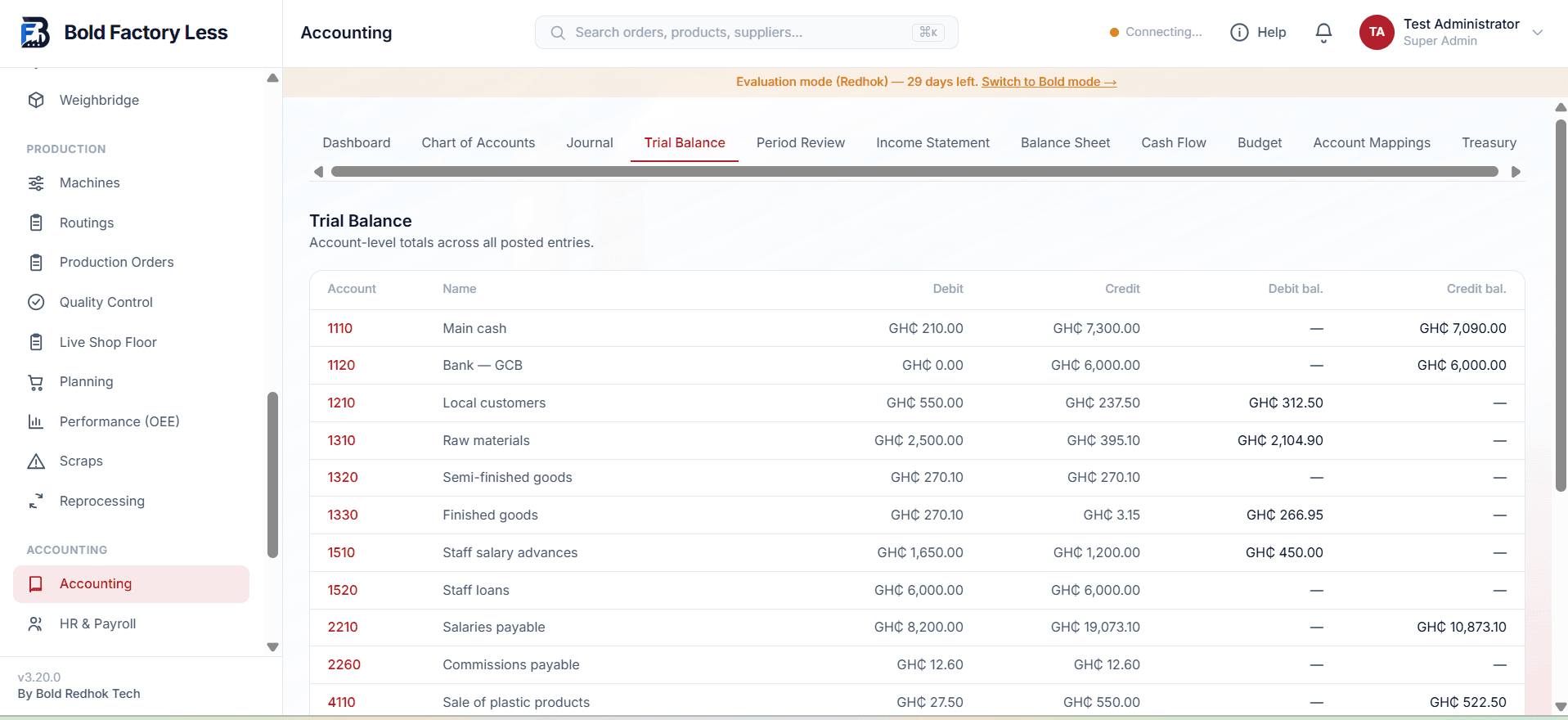
Six pages you can hand to a bank: what the year produced, what the material cost, what is still owed. Each figure is reached twice, by two independent paths, and if the two disagree, the document prints the difference instead of hiding it.
10It works where the network does not
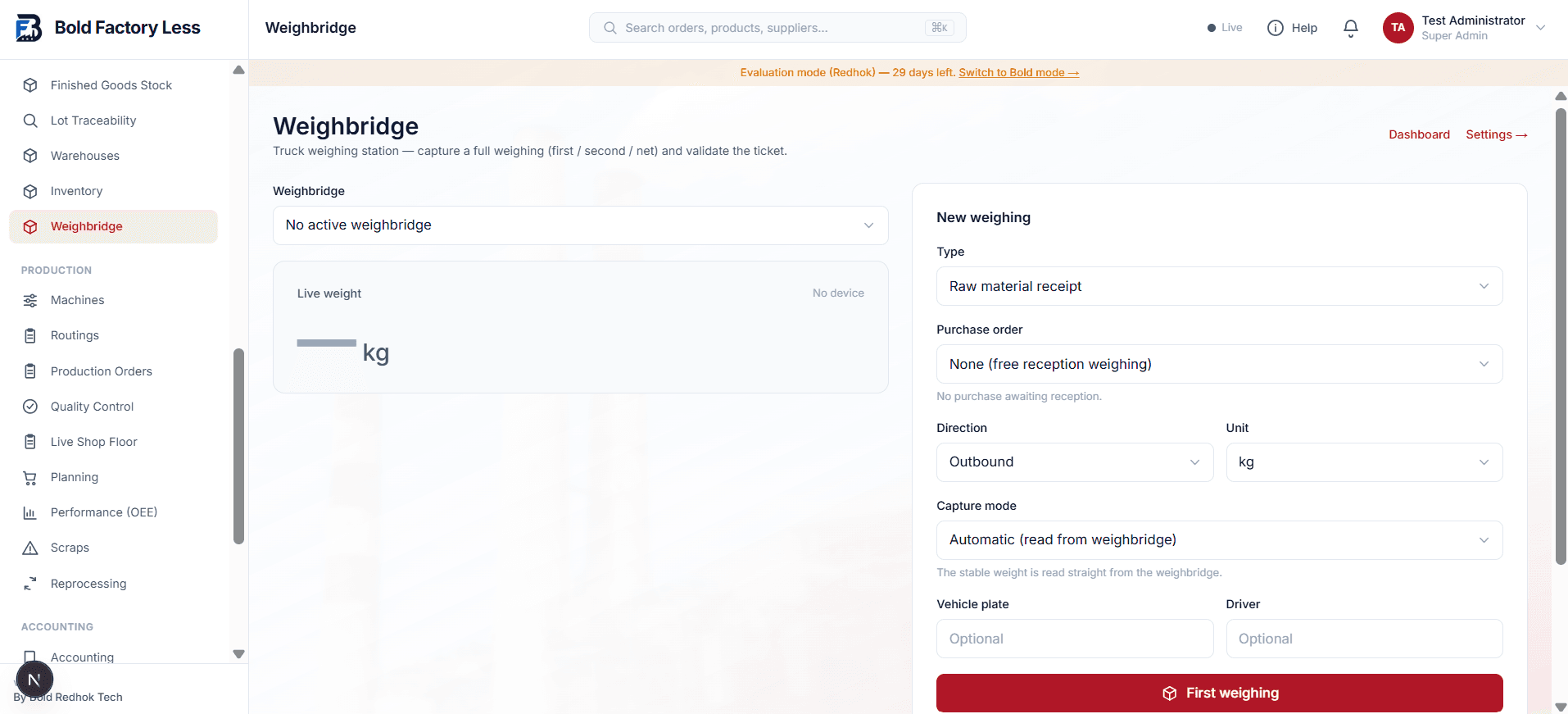
Installed on site, the factory keeps working when the internet drops. Tablets and phones are first-class: every screen is built to be used standing, in a warehouse, on a 393-pixel display.
11Your data stays with you
The software installs on your own server, under your own domain, with a certificate in your name. Your database is reachable from no public address. Each night one backup carries your accounts and your attachments together, because accounts restored without their documents prove nothing. And the backup is put to the test on a throwaway database: a backup never restored is not a backup, it is a belief.
12It refuses to spend money you do not have
A cash box can no longer go negative without anyone noticing. When a payment exceeds what the account holds, it is refused, and the refusal says how much is missing, instead of leaving a balanced balance sheet lying about your cash.
13Your taxes stop piling up on a balance sheet
The VAT you collected, the tax withheld on salaries and the social contributions are paid from the software itself. The screen shows what you owe, computed from your entries and never from a re-entry; you settle all of it, or the part you can this month. The receipt from the administration is filed next to the payment.
14A distant delivery stops looking as profitable as the one next door
Fuel, tolls and the hired carrier's invoice attach to the trip that consumed them. The cost is shared between the orders the truck carried, by weight, and each delivery shows what it really earned. On our test set, transport reverses the ranking of two orders.
15Your teams get a manual, not a training to ask for again
Two handbooks ship with the software. One follows a batch through production, quality and rework, and lists the twenty-two refusals the software can oppose, with their exact wording and the gesture that lifts each one. The other answers the four questions an audit firm asks about somebody else's software. Both end with what the product does not do, because that is the half that earns the rest.
16A large payment waits for management
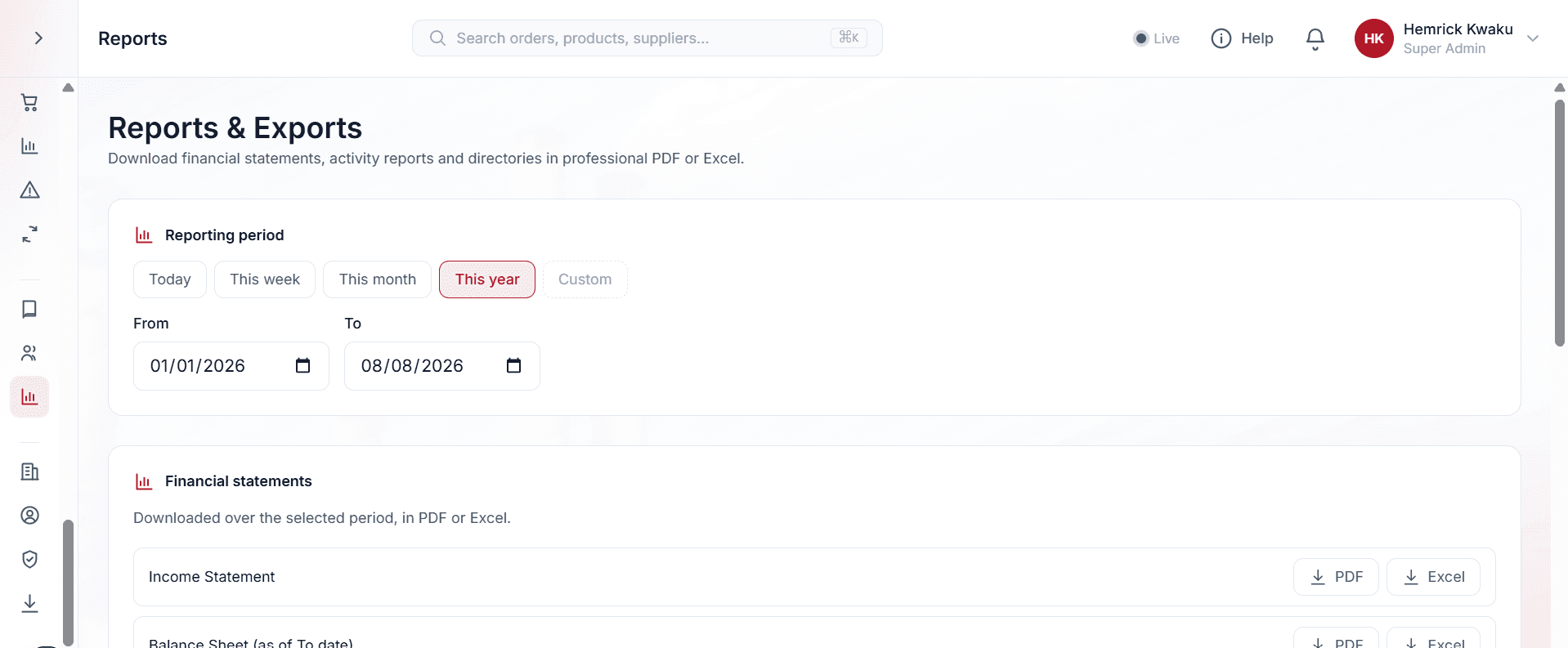
You set the amount above which a disbursement stops being routine. Beyond it, supplier payments, expenses, salaries and customer refunds all wait, and management approves or refuses from its own screen. The entry is born at the approval, not before: as long as nobody has decided, the ledger holds nothing, and the ledger can prove it. The person who asked reads it on screen instead of believing the money gone, and every decision carries the name of whoever took it.
17The money leaves the account you name
A factory rarely holds one account. The rent leaves one bank, wages another, the phone bill a mobile money wallet. Every payment, expense, purchase or salary now leaves the exact account you name, and comes back to that same account if it is cancelled. Pick a bank account then switch to cash, and the software refuses instead of quietly posting cash against a bank. Nothing changes if you never name one: the default keeps being used.
18What the workshop did not use goes back to the store
The run needed less than planned. Instead of keeping the surplus on a shelf or throwing it away, production declares what is going back and says why. Nothing moves at that point, and the screen says so. The store then receives it and decides with the material in front of them: take it back, scrap what cannot be reused, or split between the two. What comes back re-enters at the price it left at, so your average cost does not move, and the order stops carrying material it never used.
19You type the name, the software finds it
A factory carries hundreds of materials and products. Picking one from a list you can only scroll is slow on a tablet, and it is easy to take the line next to the right one. Type any part of what you are looking for, the code or the name, and the list narrows as you type. Short lists that are not catalogues keep their plain drop-down: there is nothing to search through in three entries.
20What you make yourself counts in the price
Many factories make part of what they use: the drum, the cap, the bulk. Most software treats them as bought goods or ignores them. Here the component leaves the finished-goods store by its own batches, its cost enters the product that contains it, and the software refuses to declare a batch whose recipe called for a component that never came out. An order whose cost is incomplete says so, on its own screen, and stops saying it the day the component is issued.
21Every store is real, and a lot is always somewhere
Every receipt, issue, delivery, return and count names the store it acts in, prefilled so nobody is slowed down, and a storekeeper can be limited to their own stores. Open a lot and you see how much of it sits in each one. Moving goods from one store to another is a document: it waits in draft, travels in transit without changing either the total or the value of your stock, and the destination records what actually arrived, in several times if the truck comes back. What never arrives does not vanish: it goes to dispute, and a manager settles it, found or lost, on an account of its own.
22The count stops turning tidying up into a loss
Stock is counted lot by lot, and the counter never sees the quantity expected: each lot finds its real place, and a lot found where nobody expected it is added on the spot. A lot counted short in one store and found long in another is a lot that was put away wrong, not a loss, and it is corrected without an accounting entry. What the count will post as a loss or a gain is shown before you validate, on the screen and in the report your accountant reads, and if stock moved while you were counting, the screen names what moved.
23Goods leave once, and the customer knows which lot
A delivery note is issued from an issued invoice, and from nowhere else, so the same sale can no longer leave twice; the storekeeper still finds it by the order number. The paper the customer signs lists the lots that left, and the invoice file shows its delivery notes, one click away, and the lots delivered for each article. While nothing has left the warehouse, the invoice can only be cancelled in full, never partly credited for goods that never moved. And what comes back damaged is set aside in a hold store, lot by lot, out of sellable stock, until it is written off with its entry or allocated to staff.
24The workshop says what it really used
The cost of a product is what went into the machine, not what the recipe planned. In front of each material, the workshop declares what the run really used; what the store had not served leaves stock through that very gesture, and what is left over goes back to the store, which confirms it. An order does not close without that declaration, and the reports show what went beyond the recipe, in quantity and in cost. Material that orders closed long ago never took out is listed and caught up in one click, dated the day the order was closed, so a month already closed is never rewritten behind your back.
25What you give away is counted
Ten bought, two free is written on the invoice itself, and the goods leave stock at cost as a sales expense instead of a sale at zero that would inflate your stock. A gift to a visitor or to an administration, and an allocation to your own staff, go through their own screen, with who received it and why, each landing on its own account: you can answer what the quarter was given away, and to whom. The discount granted to a customer, by your early payment rule or typed in amount at the counter with its reason, is read on an account of its own and printed on the receipt, so you know what your collection policy costs you.
26Every authority, every deadline, on one screen
The tax office, customs, the local assembly, the social security fund and the regulators each owe you a calendar. Here they share one: every obligation with its dated rate and its due date, recorded the day it arises, declared, then paid through the approval gate, and what you owe each authority reads on its own statement like a supplier's. A permit paid in January is spread over its twelve months instead of sinking January. For Ghana, one click installs the GRA, SSNIT, your assembly and the EPA with their rates, checked on their official sources, and touches nothing you had already set up.
27Pay a supplier, the withholding tax is done
The software keeps back what the law requires: the right nature from what is paid, goods, services or rent, on the amount before VAT, at the rate of the day for a resident or not, once the supplier's payments of the year pass the threshold. You may keep back another amount, but you say why, and the reason stays on the payment. The supplier leaves with a numbered certificate, and the month's schedule to file is checked against your ledger, to the cent.
28Your people have their own section, and their own keys
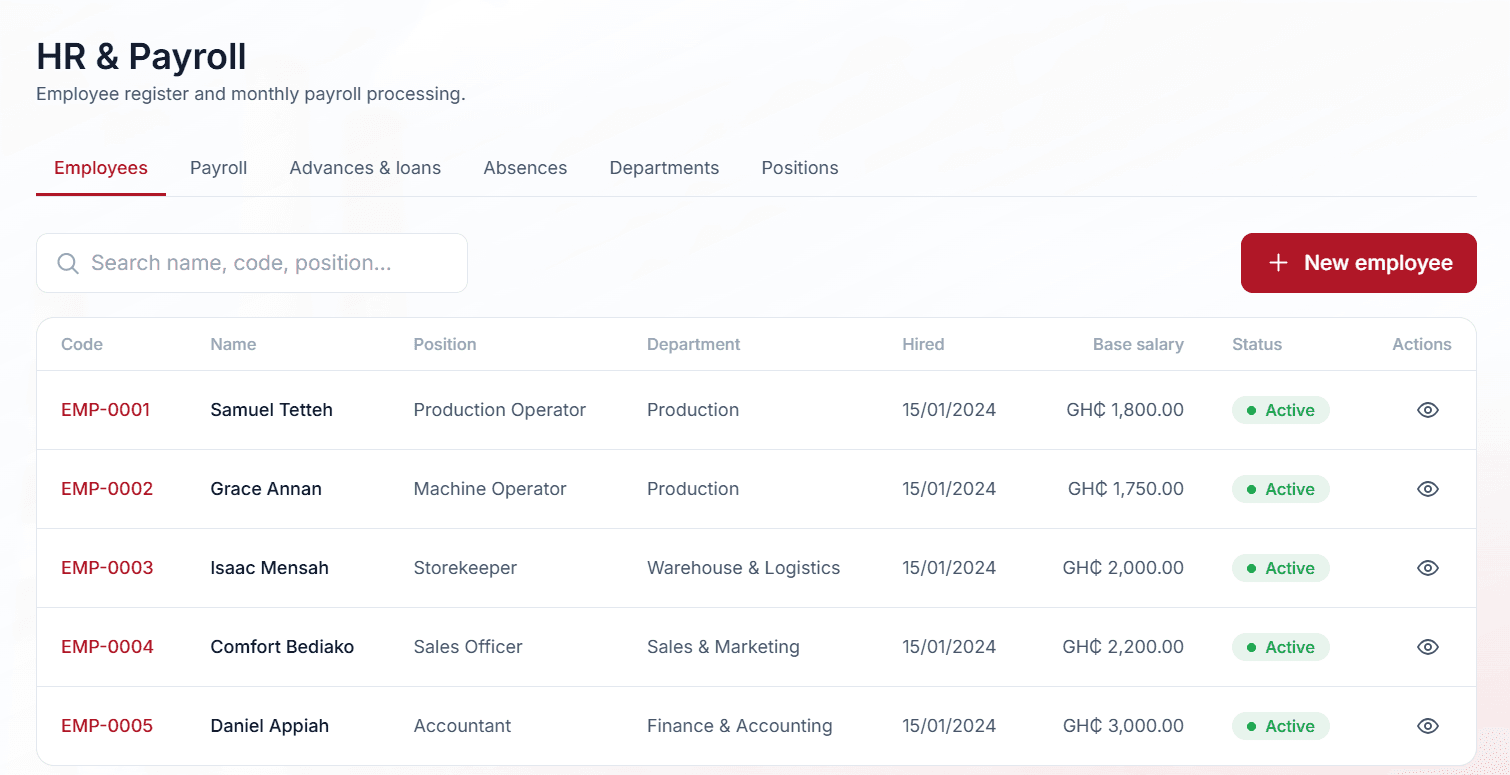
HR keeps the people, their careers and their time; the payroll officer prepares and pays; the accountant disburses. Attendance is recorded from a tablet against the planned schedule, hours and overtime are computed, never typed, and payroll pays them at your rates, monthly, twice a month or by the day, without ever paying the same day twice. Contractors and agency staff are recorded without a payslip. When someone leaves, the final settlement is paid to the half-day and the person leaves with a certificate of employment that says nothing it should not. And your dashboard shows what your workforce costs, not only what it takes home.
29A mistake is undone exactly, never guessed
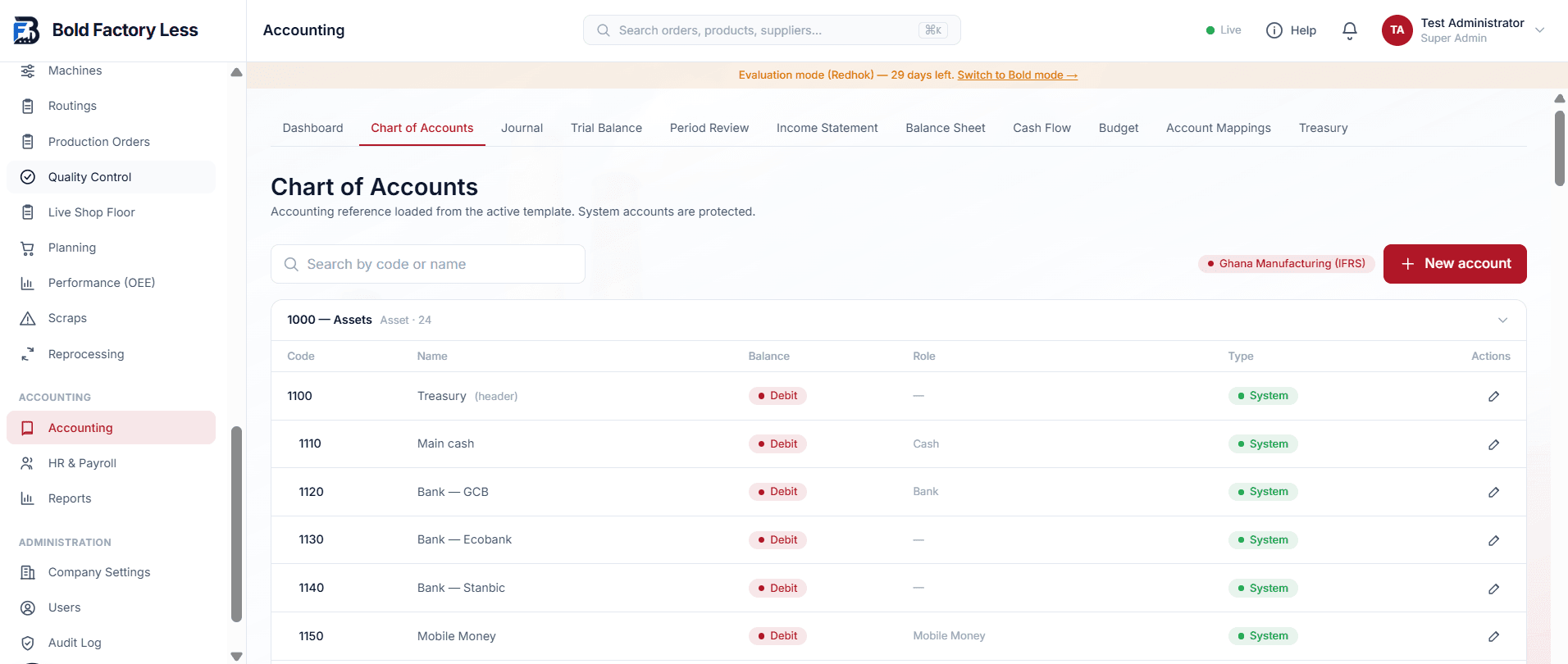
A payment keyed twice, a supplier paid the wrong amount, a manual entry on the wrong account, an opening taken over with the wrong figure: each is undone by its own gesture, which reads back the entry it undoes and returns it line by line on the accounts really used. The document stays visible, marked Cancelled, with its reason. Delete removes an item from every list without ever erasing it, and the Super Admin can restore it. Reorganise your chart of accounts today: tomorrow's corrections stay exact.
30Your bank loans follow themselves
A loan enters the books the day the money arrives, on the account you name. Its schedule is built at drawdown and adjusts to the bank's own table; each instalment paid writes one entry that separates capital, interest and penalty, above your approval ceiling if it is large. What you still owe is never typed: it is deduced from what you paid, lender by lender.
31Month end, checked before it is closed
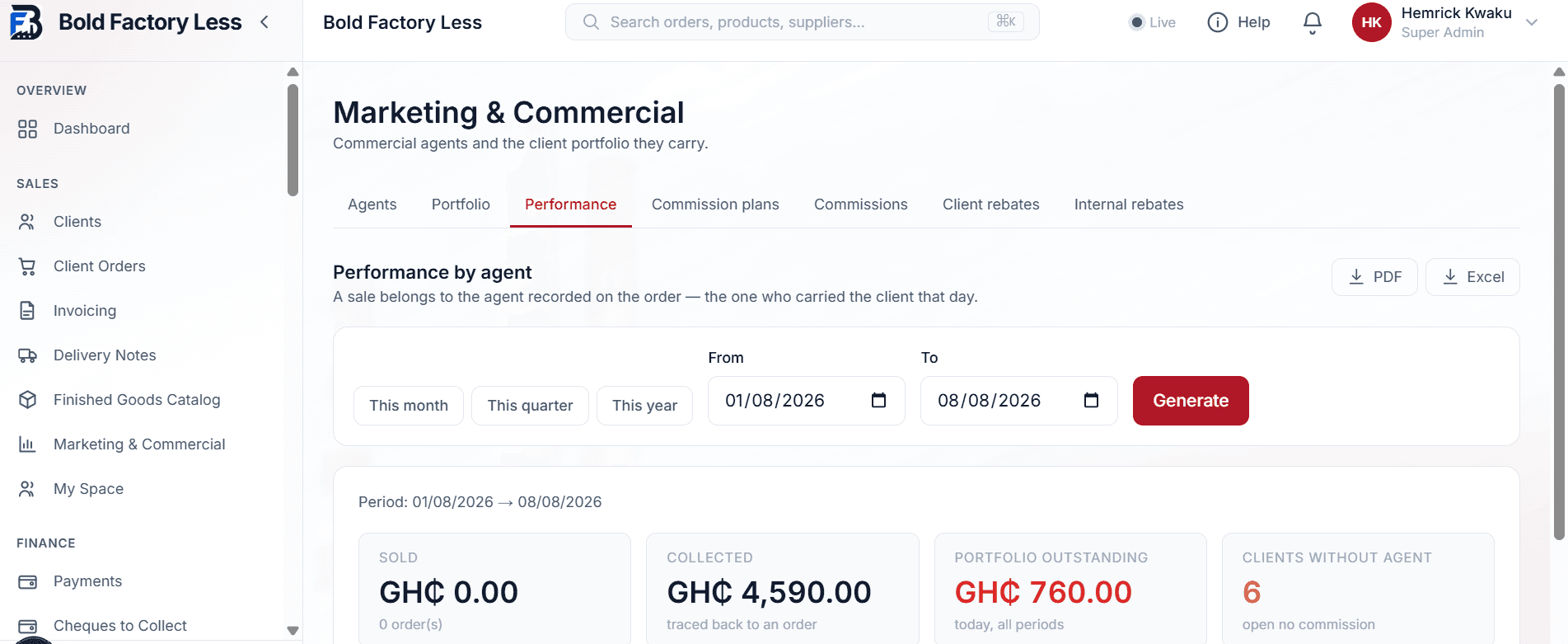
Sold, collected, still owed, overpaid and paid but not delivered, over the period you choose, each figure next to the ledger's, with a one-page summary for the meeting. Opening stock taken over at the wrong cost is brought back to its real cost in one gesture, and the cost of sales already posted follows. Foreign exchange gains and losses have their own register, with the two rates of every operation. And before the first update reaches your server, we measure your own database: that is how we catch what no test sees.
32A gap is named, never left to find
Sales of the period shows every invoice excluding tax, its tax and what the customer pays, then checks by itself that the total excluding tax is what the ledger carries in sales. When the two differ, the screen lists the invoices and credit notes that make the difference. The aged balance does the same against the customers' account. Your accountant no longer hunts for a gap: he reads it.
33The customer wants VAT after all? Re-issue the invoice
Even when it has been paid. One button cancels the invoice with a credit note and issues a new one at the same price excluding tax, with VAT on every line. What the customer already paid is carried over, so he owes only the VAT. Goods already delivered count for the new invoice and never leave twice, and the invoice he received is never rewritten. Only the people you allow can do it, and they say why.
34The shop floor counts what it holds in its hand
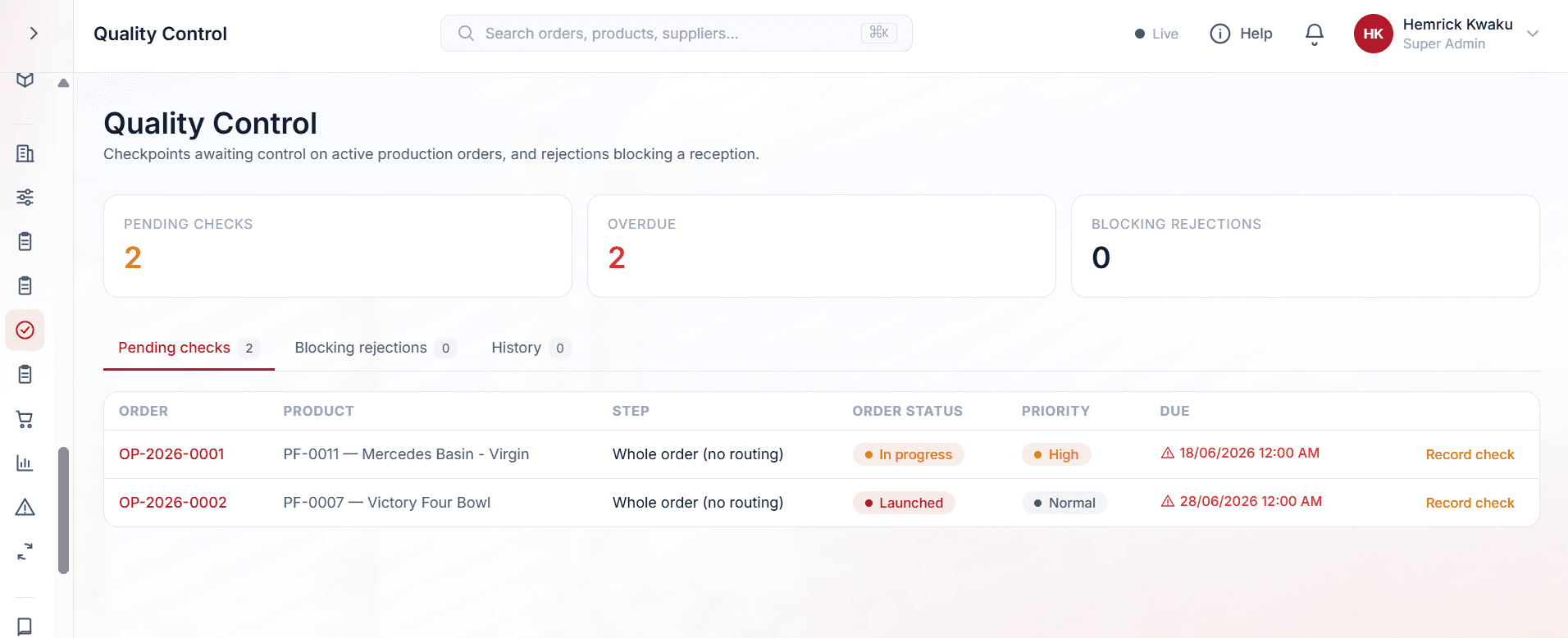
A carton does not come in quarters: jars, cartons and labels leave the store in whole units, counted on the whole order, so twelve more jars never open a second carton. Before an order closes, the workshop sees every material, planned, requested, released and consumed, and sends the rest back to the store in one click, or declares part of it damaged; the store confirms. The quality check counts apart the units a test used up, and their cost goes to the good units, as IAS 2 requires.